Supreme Court on Section 161 CrPC Statements at the Cognizance Stage
The Supreme Court of India has held that statements recorded by the police under Section 161 of the Code of Criminal Procedure, 1973 (CrPC), or Section 180 of the Bharatiya Nagarik Suraksha Sanhita, 2023 (BNSS), cannot be relied upon at trial but may be considered by a Magistrate at the stage of taking cognizance.
In Mrityunjay Kumar Chaudhary v. State of Bihar & Anr., the Supreme Court set aside the Patna High Court's decision interfering with a Magistrate's order taking cognizance despite the police having submitted a closure report.
Key Takeaways
- Section 161 CrPC (Section 180 BNSS) statements cannot be relied upon at trial.
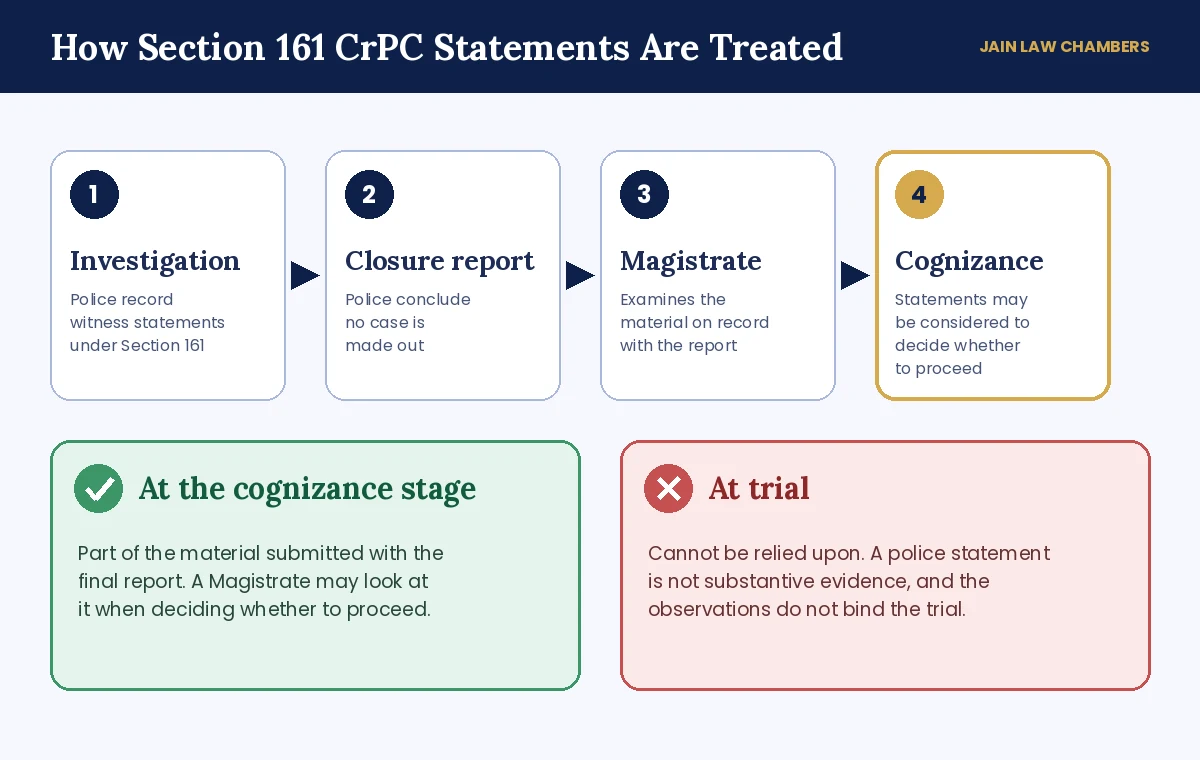
- They may be considered at the cognizance stage, as they form part of the material submitted by the police with the final report.
- A closure report does not bar a Magistrate from taking cognizance where the material on record justifies proceeding.
- Observations made while considering cognizance do not govern the eventual trial.
Case Details
- Case: Mrityunjay Kumar Chaudhary v. State of Bihar & Anr.
- Court: Supreme Court of India
- Bench: Justice J.B. Pardiwala and Justice K. Vinod Chandran
- Appeal: Criminal Appeal arising out of SLP (Crl.) No. 18490 of 2026
- Date of order: 9 October 2026
Background of the Case
The case arose from the death of the appellant's son by drowning. The appellant alleged that the accused had played an active role in his son's death. The case also involved circumstantial material and statements of witnesses who had allegedly seen the accused running away from the spot.
Following the investigation, the police submitted a closure report, concluding that no case was made out. The appellant challenged the report, and the matter subsequently came before the Magistrate for reconsideration.
The Magistrate eventually took cognizance of offences under Sections 302 and 201 of the Indian Penal Code, 1860. The Patna High Court interfered with that order, following which the appellant approached the Supreme Court.
Supreme Court's Observations
The Supreme Court observed that statements recorded under Section 161 CrPC cannot be relied upon at trial but may be examined at the cognizance stage, as they form part of the material submitted by the police along with the final report.
The Court also reiterated that a Magistrate is not prevented from taking cognizance merely because the police have filed a closure report. On receiving such a report, a Magistrate may accept it and close the proceedings, take cognizance on the material in the report, or direct further investigation. The court must consider the material available on record and determine whether there are sufficient grounds to proceed.
Finding no reason to interfere with the cognizance order in the facts of the case, the Supreme Court set aside the High Court's decision and restored the Magistrate's order.
Importantly, the Court clarified that the observations made by the revisional court, the Magistrate and the Supreme Court while considering cognizance would not govern or influence the eventual trial.
Legal Significance
The decision highlights the distinction between considering material collected during an investigation at the cognizance stage and relying upon evidence during trial. The fact that a police statement may be considered for deciding whether proceedings should continue does not make it substantive evidence at trial.
The judgment also reiterates that a closure report submitted by the investigating agency does not, by itself, prevent the Magistrate from taking cognizance where the circumstances and material on record justify proceeding in accordance with law.
For complainants and accused persons alike, the ruling is a reminder of how differently the same material is treated at different stages of a criminal case. Our criminal law practice regularly deals with these stages, from the filing of a closure report and protest petition to cognizance, revision and quashing proceedings.
Conclusion
The Supreme Court's ruling in Mrityunjay Kumar Chaudhary v. State of Bihar & Anr. clarifies the permissible consideration of police statements at the cognizance stage while preserving the distinction between preliminary judicial assessment and trial. It further reinforces the Magistrate's authority to independently consider the material on record, even when the police have submitted a closure report.
Frequently Asked Questions
Can Section 161 CrPC statements be used as evidence at trial?
No. The Supreme Court has held that statements recorded by the police under Section 161 CrPC cannot be relied upon at trial. A police statement does not become substantive evidence simply because it was considered at an earlier stage.
Can a Magistrate consider Section 161 CrPC statements while taking cognizance?
Yes. These statements form part of the material submitted by the police along with the final report, so a Magistrate may examine them while deciding whether there are sufficient grounds to proceed.
Can a Magistrate take cognizance even if the police file a closure report?
Yes. A closure report does not, by itself, prevent a Magistrate from taking cognizance. The Magistrate must consider the material on record and decide whether there are sufficient grounds to proceed in accordance with law.
What is the BNSS equivalent of Section 161 CrPC?
Statements recorded by the police during investigation fall under Section 180 of the Bharatiya Nagarik Suraksha Sanhita, 2023 (BNSS), which corresponds to Section 161 of the Code of Criminal Procedure, 1973.
Do the Supreme Court's observations at the cognizance stage affect the trial?
No. The Court clarified that the observations made by the revisional court, the Magistrate and the Supreme Court while considering cognizance will not govern or influence the eventual trial.
Related Reading
- Breach of Contract or Cheating? Supreme Court Quashes Criminal Case Over ₹40 Lakh Dispute
- What Should You Do Immediately After Receiving a Police Notice?
- Criminal Law Practice at Jain Law Chambers
- Contact Jain Law Chambers
Share: