
Breach of Contract or Cheating? Supreme Court Ruling on a ₹40 Lakh Dispute
Can a failed business transaction lead to criminal prosecution for cheating? In Indroneel Goho v. Razouvonuo Thong & Anr., 2026 INSC 1115, the Hon’ble Supreme Court examined this question while dealing with a dispute arising out of a commercial agreement concerning a tea estate.
Key Takeaways
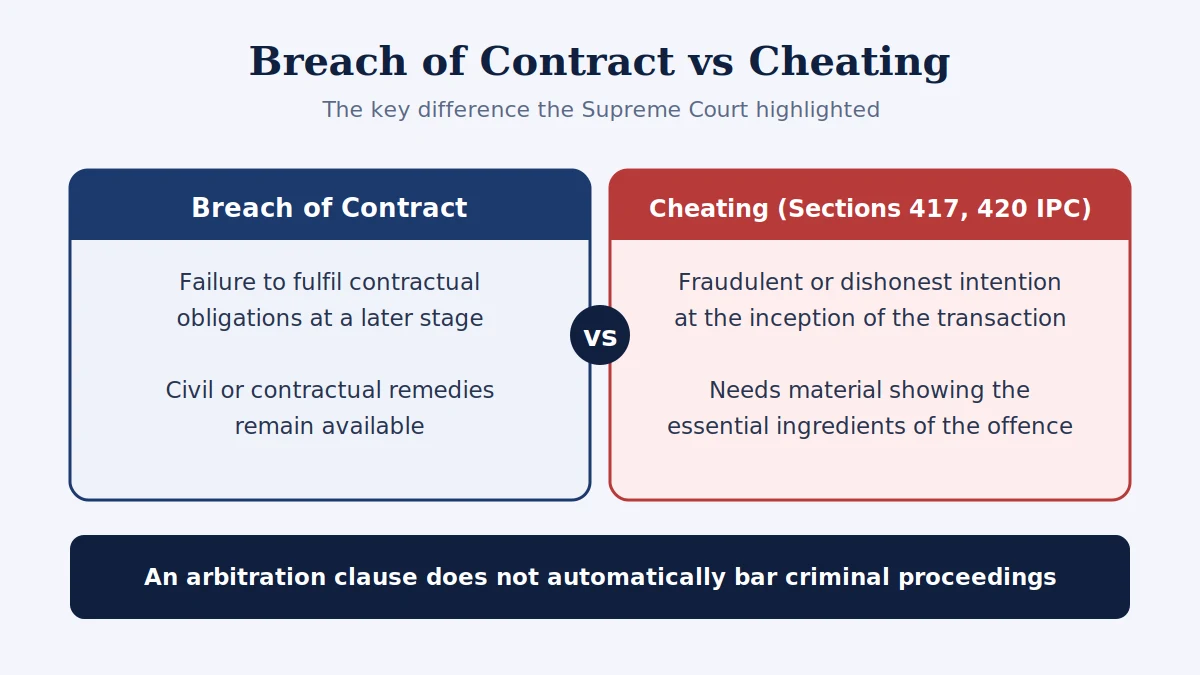
- Cheating requires fraudulent or dishonest intention at the inception of the transaction
- A later failure to fulfil contractual obligations does not, by itself, establish such intention
- An arbitration clause does not automatically bar criminal proceedings
- The complainant’s right to pursue civil or contractual remedies was preserved
Background of the Case
The appellant, CEO of Darjeeling Organic Tea Estates Private Limited, had signed a Memorandum of Understanding (MoU) with C.R. Traders concerning the Jamguri Tea Estate in Assam. The complainant transferred ₹40 lakh to the company’s bank account.
Following disputes over the agreement, the MoU was terminated, and the complainant initiated criminal proceedings alleging cheating under Sections 417 and 420 of the Indian Penal Code, 1860.
The appellant sought quashing of the proceedings, contending that the dispute was contractual and that he had signed the agreement only as the company’s authorised representative.
What Did the Hon’ble Supreme Court Hold?
The Hon’ble Supreme Court held that cheating requires fraudulent or dishonest intention at the inception of the transaction. A subsequent failure to fulfil contractual obligations does not, by itself, establish such intention.
The Court noted that the agreement had been executed by the company, the money had been transferred to its account, and there was no allegation that the appellant had personally received or appropriated the funds. Considering the circumstances of the transaction, the Court found that the essential ingredients of cheating were not made out against him.
The Court also clarified that an arbitration clause does not automatically bar criminal proceedings. The decisive question is whether the allegations disclose the ingredients of the alleged offence.
Accordingly, the Hon’ble Supreme Court set aside the High Court’s order and quashed the criminal proceedings against the appellant, while preserving the complainant’s right to pursue available civil or contractual remedies.
Conclusion
The judgment reiterates an important principle: every breach of contract does not amount to cheating. Criminal proceedings must be supported by material disclosing the essential ingredients of the alleged offence, including dishonest intention at the inception of the transaction where cheating is alleged.
Jain Law Chambers advises and represents clients in commercial disputes, contractual litigation and criminal proceedings.
FAQ’s
1. Does every breach of contract amount to cheating?
No. The Supreme Court reiterated that every breach of contract does not amount to cheating. Criminal proceedings must be supported by material disclosing the essential ingredients of the alleged offence.
2. When does a failed business transaction become cheating?
Cheating requires fraudulent or dishonest intention at the inception of the transaction. A subsequent failure to fulfil contractual obligations does not, by itself, establish such intention.
3. Does an arbitration clause bar criminal proceedings?
Not automatically. The Supreme Court clarified that the decisive question is whether the allegations disclose the ingredients of the alleged offence.
4. Which case decided that a contractual dispute is not automatically cheating?
The ruling was delivered in Indroneel Goho v. Razouvonuo Thong & Anr., 2026 INSC 1115, a dispute arising from an MoU concerning the Jamguri Tea Estate in Assam, where the complainant had transferred ₹40 lakh.
5. Why did the Supreme Court quash the proceedings against the appellant?
The agreement had been executed by the company, the money had been transferred to the company’s account, and there was no allegation that the appellant had personally received or appropriated the funds. The Court found that the essential ingredients of cheating were not made out against him.
6. Can the complainant still seek civil remedies after the criminal case is quashed?
Yes. While quashing the criminal proceedings, the Supreme Court preserved the complainant’s right to pursue available civil or contractual remedies.
Disclaimer: This article is for general informational purposes only and does not constitute legal advice.
Share: