
Can a WhatsApp Message Prove Murder? Supreme Court Ruling on Circumstantial Evidence
Can a WhatsApp conversation become the basis of a murder conviction when the witnesses deny the incident and the remaining evidence fails to establish a complete chain of circumstances?
In Kusumlal Sao v. State of Chhattisgarh, Criminal Appeal No. 4894 of 2026, the Hon’ble Supreme Court of India examined this question and set aside the appellant’s conviction for murder and disappearance of evidence under Sections 302 and 201 of the Indian Penal Code, 1860. The judgment highlights the importance of evaluating electronic communications alongside the entire body of evidence in a criminal trial.
Key Takeaways
- A WhatsApp message cannot independently establish guilt when its authorship, source or connection with the offence is uncertain
- In a case based on circumstantial evidence, the circumstances must form a complete chain and exclude reasonable alternative explanations
- Suspicion, however strong, cannot take the place of proof beyond reasonable doubt
- The Supreme Court acquitted the accused and set aside the judgments of the trial court and the High Court
The WhatsApp Messages That Became Central to the Case
The deceased, Saurabh Panda, was found dead in an open field on 9 February 2019, with his motorcycle and a yellow rope nearby. During the investigation, the police recovered WhatsApp messages allegedly sent by one prosecution witness to another, referring to a fight involving the accused and the deceased.
The trial court relied on these messages, along with alleged recoveries of an iron rod, a screwdriver and blood-stained articles, to convict the accused. The Chhattisgarh High Court upheld the conviction.
However, during the trial, both witnesses denied witnessing the incident. The witness alleged to have sent the WhatsApp message also denied having sent it.
Why Did the Hon’ble Supreme Court Set Aside the Conviction?
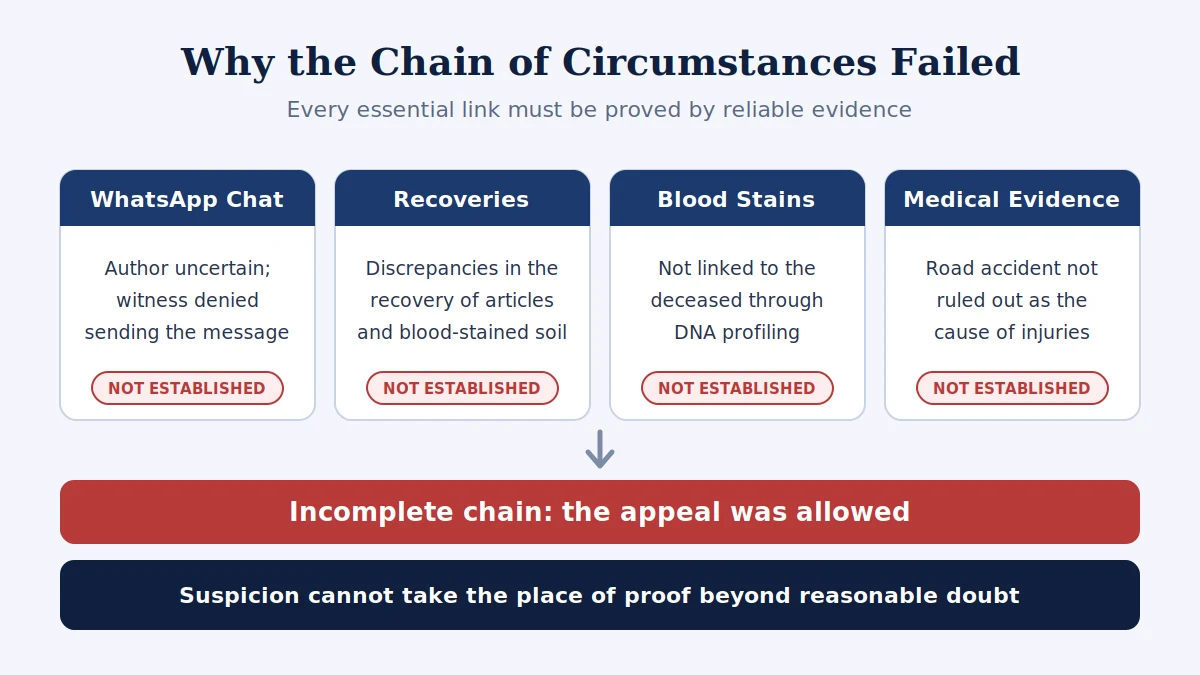
The Hon’ble Supreme Court found that the WhatsApp exchange did not establish that the deceased was present at the accused’s house or that the accused had assaulted him. The identity of the message’s author and the basis of the information contained in it remained uncertain.
The Court also noted discrepancies in the evidence concerning the recovery of blood-stained soil and other articles. The blood stains could not be linked to the deceased through DNA profiling, and the medical evidence did not rule out the possibility that the injuries had resulted from a road accident.
Since the prosecution case rested entirely on circumstantial evidence, these deficiencies assumed particular importance.
Suspicion Cannot Replace Proof Beyond Reasonable Doubt
Reiterating the settled principles governing circumstantial evidence, the Hon’ble Supreme Court observed that the circumstances relied upon by the prosecution must form a complete chain pointing towards the guilt of the accused and must exclude reasonable alternative explanations.
The Court emphasised that an accused must be proved guilty, not merely appear to be guilty. The WhatsApp messages, at best, created suspicion, which was insufficient to sustain a conviction.
Finding that the evidence did not provide a sufficient basis for the conviction, the Hon’ble Supreme Court allowed the appeal, set aside the judgments of the trial court and High Court, and acquitted the appellant.
Conclusion
The judgment in Kusumlal Sao v. State of Chhattisgarh reiterates that electronic communications must be assessed in their proper evidentiary context. A message that appears incriminating cannot independently establish guilt when its authorship, source or connection with the alleged offence remains uncertain.
The decision also reinforces a fundamental principle of criminal law: where the prosecution relies on circumstantial evidence, every essential link must be established through reliable evidence, and suspicion cannot take the place of proof beyond reasonable doubt.
Jain Law Chambers advises and represents clients in criminal litigation, trial proceedings and matters involving electronic evidence and evidentiary challenges.
Related Reading
- Section 161 CrPC statements at the cognizance stage: Supreme Court ruling
- Prolonged pre-trial detention and bail under Article 21
- What to do after receiving a police notice in Delhi
FAQ’s
1. Can a WhatsApp message alone prove murder?
No. The Supreme Court observed that a message that appears incriminating cannot independently establish guilt when its authorship, source or connection with the alleged offence remains uncertain. Electronic communications must be assessed alongside the entire body of evidence.
2. Why did the Supreme Court set aside the murder conviction?
The WhatsApp exchange did not establish that the deceased was present at the accused’s house or that the accused had assaulted him. The Court also noted discrepancies in the recovery evidence, the absence of a DNA link between the blood stains and the deceased, and medical evidence that did not rule out a road accident.
3. What is the standard for convicting on circumstantial evidence?
The circumstances relied upon by the prosecution must form a complete chain pointing towards the guilt of the accused and must exclude reasonable alternative explanations. Every essential link must be established through reliable evidence.
4. What happened to the witnesses in this case?
Both prosecution witnesses denied witnessing the incident during the trial. The witness alleged to have sent the WhatsApp message also denied having sent it.
5. Which case decided that WhatsApp messages cannot alone prove guilt?
The ruling was delivered in Kusumlal Sao v. State of Chhattisgarh, Criminal Appeal No. 4894 of 2026. The Supreme Court set aside the conviction under Sections 302 and 201 of the Indian Penal Code, 1860, and the judgments of the trial court and the Chhattisgarh High Court.
6. Can suspicion be the basis of a criminal conviction?
No. The Court emphasised that an accused must be proved guilty, not merely appear to be guilty. Suspicion, however strong, cannot take the place of proof beyond reasonable doubt.
Disclaimer: This article is intended for general informational purposes only and does not constitute legal advice.
Share: