

Prolonged Pre-Trial Detention and Article 21: Supreme Court Ruling on Bail
Can an accused remain in custody indefinitely merely because the allegations against them are serious? The Supreme Court of India has reiterated that prolonged pre-trial detention cannot become punishment before conviction, emphasising the importance of personal liberty and the right to a speedy trial under Article 21 of the Constitution.
In Mahesh Chandra Joshi v. State of Rajasthan and Mukesh Pathak v. State of Rajasthan, 2026 INSC 1141, the Court granted regular bail to two accused in a corruption case relating to alleged irregularities in tenders under the Jal Jeevan Mission in Rajasthan.
Key Takeaways
- The seriousness of the allegations cannot be the sole consideration in deciding whether an accused should remain in custody
- The right to a speedy trial is an important part of the Article 21 guarantee
- Bail must be decided on the individual circumstances of each case
- The ruling does not make bail automatic in serious corruption cases
Why Did the Supreme Court Grant Bail?
The case involved allegations of large-scale irregularities in public tenders, with the work orders in question aggregating approximately ₹979.45 crore. The prosecution alleged that forged work completion certificates and letters of acceptance were used to secure contracts.
The Supreme Court acknowledged the seriousness of the allegations but held that their gravity alone could not justify indefinite pre-trial detention.
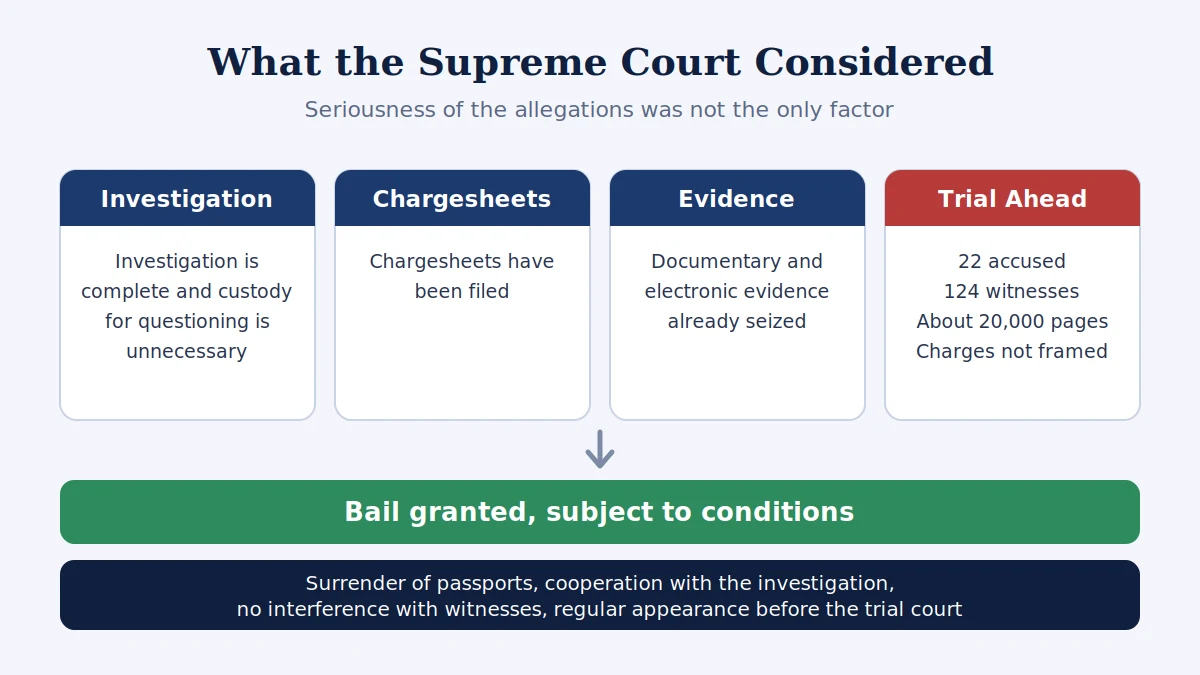
The Court considered several factors, including the completion of the investigation, the filing of chargesheets and the fact that the prosecution’s case relied substantially on documentary and electronic evidence already seized by the investigating agency.
It also took note of the appellants’ periods of custody and the likely duration of the trial. The case involved 22 accused, 124 prosecution witnesses and approximately 20,000 pages of documents, while charges had not yet been framed.
Considering these circumstances together, the Court concluded that further incarceration was neither warranted nor necessary.
Serious Allegations Do Not Automatically Justify Continued Detention
The Supreme Court emphasised that the seriousness of the allegations cannot be the sole consideration in deciding whether an accused should remain in custody.
Where the investigation is complete, further custodial interrogation is unnecessary and the trial is likely to take considerable time, continued detention must be assessed against the accused’s right to personal liberty and a speedy trial.
The Court also considered that the relevant documentary and electronic evidence had already been secured. It directed the release of both appellants on bail, subject to conditions including surrender of passports, cooperation with the investigation, non-interference with witnesses and regular appearance before the trial court.
Importance of Article 21 in Bail Matters
Article 21 of the Constitution protects life and personal liberty. The right to a speedy trial forms an important part of this constitutional guarantee.
The judgment reinforces that bail decisions require an assessment of the individual circumstances of each case. The seriousness of the alleged offence remains relevant, but it must be considered alongside factors such as the progress of the investigation, the likelihood of trial delays, the nature of the evidence and the necessity of continued custody.
The ruling does not make bail automatic in serious corruption cases. Instead, it reiterates that detention before conviction must remain justified by the circumstances of the case and the applicable legal principles.
Conclusion
The Supreme Court’s decision reiterates a fundamental principle of criminal jurisprudence: pre-trial detention must not become a substitute for punishment. The right to personal liberty and a speedy trial remains relevant even where the allegations involve serious financial wrongdoing.
The judgment is a reminder that bail applications must be assessed on their individual merits, taking into account both the interests of the prosecution and the constitutional protections available to an accused.
Jain Law Chambers advises and represents clients in criminal litigation, bail proceedings and matters involving the protection of constitutional rights.
FAQ’s
1. Can serious allegations alone justify keeping an accused in custody?
No. The Supreme Court emphasised that the seriousness of the allegations cannot be the sole consideration in deciding whether an accused should remain in custody. Continued detention must be assessed against the accused’s right to personal liberty and a speedy trial.
2. How is Article 21 relevant to bail?
Article 21 of the Constitution protects life and personal liberty, and the right to a speedy trial forms an important part of this guarantee. Bail decisions require an assessment of the individual circumstances of each case.
3. Which case decided that pre-trial detention cannot become punishment?
The ruling was delivered in Mahesh Chandra Joshi v. State of Rajasthan and Mukesh Pathak v. State of Rajasthan, 2026 INSC 1141, a corruption case relating to alleged irregularities in tenders under the Jal Jeevan Mission in Rajasthan, where the work orders aggregated approximately ₹979.45 crore.
4. What factors did the Supreme Court consider before granting bail?
The Court considered the completion of the investigation, the filing of chargesheets and the fact that the prosecution’s case relied substantially on documentary and electronic evidence already seized. It also considered the periods of custody and the likely duration of the trial, which involved 22 accused, 124 prosecution witnesses and approximately 20,000 pages of documents, with charges not yet framed.
5. What conditions were imposed on the accused?
The release on bail was subject to conditions including surrender of passports, cooperation with the investigation, non-interference with witnesses and regular appearance before the trial court.
6. Does this ruling make bail automatic in serious corruption cases?
No. The ruling reiterates that detention before conviction must remain justified by the circumstances of the case and the applicable legal principles. Each bail application must be assessed on its individual merits.
Disclaimer: This article is intended for general informational purposes only and does not constitute legal advice.
Share: