
Dowry Death Case Quashed: Why General Allegations Are Not Enough
The Supreme Court has quashed criminal proceedings against a husband accused of dowry harassment and cruelty following his wife’s death by suicide in Canada. In Piyush v. State of Maharashtra & Others, 2026 INSC 1183, decided on 2 November 2026, the Court held that general allegations, without specific incidents or supporting evidence, cannot justify the continuation of criminal prosecution.
Key Takeaways
- General allegations of dowry demand and cruelty, without specific incidents or evidence, cannot sustain a criminal prosecution
- A proximate connection between the alleged harassment and the death must be established
- Criminal proceedings may be quashed where the allegations, even if accepted in full, do not disclose an offence
- The Supreme Court set aside the Bombay High Court’s order and quashed the FIR and all consequential proceedings
Background of the Case
The couple married in January 2021 and later moved to Toronto, Canada. In June 2023, the wife died after jumping from the 22nd floor of their residential apartment. A handwritten suicide note recovered from the apartment referred to her struggles with finding employment and feelings of failure, but made no reference to her husband or any alleged matrimonial harassment.
Following her death, her father lodged an FIR against the husband and his family under Sections 304B, 323, 498A and 504 of the Indian Penal Code, along with Sections 3 and 4 of the Dowry Prohibition Act. The allegations included dowry demands, physical harassment and the husband allegedly calling his wife “stupid” and “useless”.
Supreme Court’s Observations
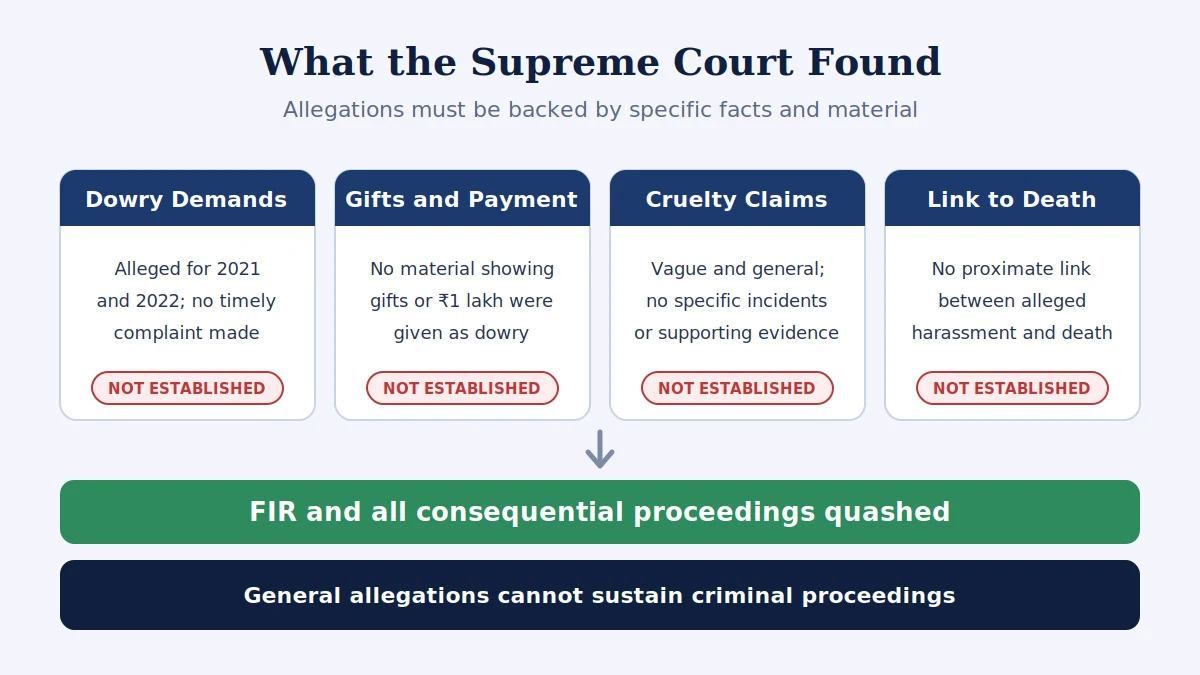
The Supreme Court examined the FIR, the suicide note, the Canadian Coroner’s report and the Toronto Police investigation report. It noted that the alleged dowry demands related to 2021 and 2022, but no contemporaneous complaint had been made. The Court also found no sufficient material to establish that the gifts exchanged during the wedding and Diwali, or the alleged payment of ₹1 lakh, were made pursuant to a dowry demand.
On the allegations of cruelty, the Court observed that the FIR contained vague and general allegations without specific instances or supporting evidence. It held that the allegation of calling the deceased “stupid” and “useless”, even if accepted at face value, was insufficient in the circumstances to constitute an offence under Section 498A or Section 504 IPC.
The Court further observed that no proximate connection had been established between the alleged harassment or dowry demands and the wife’s death.
When Can Criminal Proceedings Be Quashed?
Relying on State of Haryana v. Bhajan Lal, the Supreme Court reiterated that criminal proceedings may be quashed where the allegations, even if accepted in their entirety, do not disclose the commission of an offence, or where continuation of the proceedings would amount to an abuse of process.
Conclusion
Setting aside the Bombay High Court’s order, the Supreme Court quashed the FIR and all consequential proceedings against the husband.
The judgment reiterates that allegations of matrimonial cruelty and dowry harassment must be supported by specific facts and material. Criminal proceedings cannot be sustained merely on the basis of general allegations, particularly where the essential ingredients of the alleged offences are not made out.
Jain Law Chambers advises and represents clients in criminal litigation and matrimonial and family disputes.
Related Reading
- Misuse of domestic violence laws and quashing of proceedings in India
- Can I get maintenance under the Domestic Violence Act?
- Prolonged pre-trial detention and bail under Article 21
FAQ’s
1. Can vague allegations sustain a dowry death or cruelty case?
No. The Supreme Court held that general allegations, without specific incidents or supporting evidence, cannot justify the continuation of a criminal prosecution. Allegations of matrimonial cruelty and dowry harassment must be supported by specific facts and material.
2. What did the Supreme Court say about the alleged dowry demands?
The Court noted that the alleged dowry demands related to 2021 and 2022, but no contemporaneous complaint had been made. It also found no sufficient material to establish that the gifts exchanged during the wedding and Diwali, or the alleged payment of ₹1 lakh, were made pursuant to a dowry demand.
3. Is calling a spouse ‘stupid’ or ‘useless’ an offence under Section 498A or 504 IPC?
In this case, the Court held that the allegation of calling the deceased ‘stupid’ and ‘useless’, even if accepted at face value, was insufficient in the circumstances to constitute an offence under Section 498A or Section 504 IPC.
4. Why was a proximate connection with the death important?
The Court observed that no proximate connection had been established between the alleged harassment or dowry demands and the wife’s death. This was one of the reasons the proceedings could not be sustained.
5. When can criminal proceedings be quashed?
Relying on State of Haryana v. Bhajan Lal, the Supreme Court reiterated that criminal proceedings may be quashed where the allegations, even if accepted in their entirety, do not disclose the commission of an offence, or where continuing the proceedings would amount to an abuse of process.
6. Which case decided this, and what material did the Court examine?
The ruling was delivered in Piyush v. State of Maharashtra & Others, 2026 INSC 1183, decided on 2 November 2026. The Court examined the FIR, the suicide note, the Canadian Coroner’s report and the Toronto Police investigation report, set aside the Bombay High Court’s order, and quashed the FIR and all consequential proceedings against the husband.
Disclaimer: This article is intended for general legal information and does not constitute legal advice.
Share: