
Married Daughter and Motor Accident Compensation: Delhi High Court Ruling
The Delhi High Court has held that a married daughter, earning son, spouse or sibling cannot be denied motor accident compensation merely because they are financially independent, married or living separately from the deceased. The ruling was delivered by Justice Anish Dayal in Savita v. United India Insurance Company Ltd. on 12 November 2026.
The Court clarified that being financially independent does not automatically exclude a person from claiming compensation under the Motor Vehicles Act, 1988. Whether a claimant was financially dependent on the deceased must be examined on the facts of each case.
Key Takeaways
- A married daughter cannot be denied compensation merely because she has her own matrimonial family
- An earning family member is not automatically excluded from claiming compensation
- All legal representatives can maintain a claim under Section 166 of the Motor Vehicles Act, even without proving financial dependency
- The extent of actual dependency is relevant when calculating and apportioning compensation
Background of the Case
The matter arose from a motor vehicle accident in August 2015, in which a woman named Savita lost her father, Chamanlal, and her sister, Meenu.
The Motor Accident Claims Tribunal had awarded compensation to Savita, treating her as a legal representative who was not financially dependent on the deceased.
The insurance company challenged the award, arguing that Savita was married, had her own family and was not financially dependent on her father. It contended that her entitlement should be restricted to compensation towards loss of estate.
Savita, on the other hand, argued that she and her deceased sister were financially dependent on each other. She submitted that her sister regularly contributed towards her financial needs.
What Did the Delhi High Court Hold?
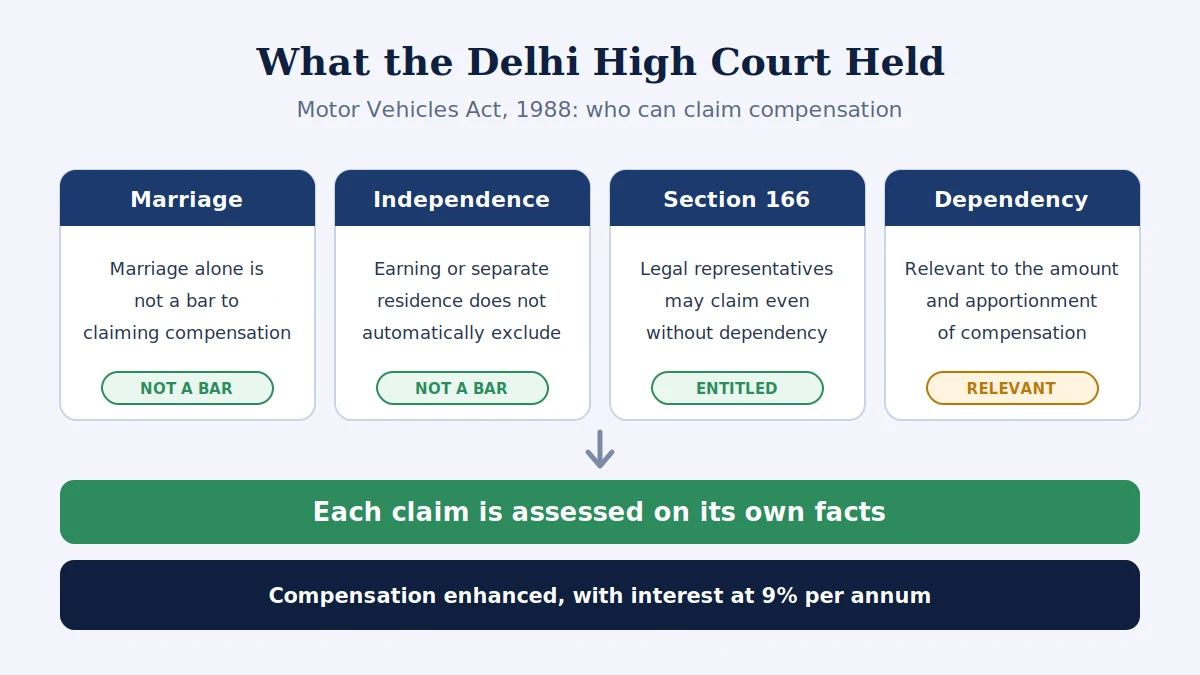
The Delhi High Court rejected the argument that marriage or financial independence automatically disentitles a person from claiming compensation.
The Court made an important distinction between a legal representative, a legal heir and a dependent, observing that these expressions cannot be treated as interchangeable.
It held that all legal representatives of a deceased person are entitled to maintain a claim under Section 166 of the Motor Vehicles Act, even if they are unable to establish financial dependency. However, the extent of dependency becomes relevant when determining the amount and apportionment of compensation.
The Court observed that financial support within Indian families does not necessarily stop merely because a daughter gets married or a family member starts living separately. Financial contributions may continue between family members even after marriage or the establishment of separate households.
Compensation Awarded
On the facts of the case, the Court treated Savita as partially dependent on her deceased father and sister.
Consequently, it enhanced the compensation payable in respect of her sister’s death from ₹9,27,100 to ₹14,38,054 and in respect of her father’s death from ₹13,15,600 to ₹20,20,871.50. It also awarded consortium compensation of ₹40,000 in respect of each death, along with interest at 9% per annum.
Why This Judgment Matters
This judgment is important for families pursuing motor accident compensation claims, particularly where the deceased leaves behind married daughters, earning children or relatives who live separately.
It clarifies that:
- A married daughter cannot be denied compensation merely because she has her own matrimonial family.
- An earning family member is not automatically excluded from claiming compensation.
- Legal representatives can maintain a claim under Section 166 of the Motor Vehicles Act even without proving financial dependency.
- The extent of actual dependency is relevant when calculating and apportioning compensation.
Conclusion
The judgment recognises that financial relationships within families are not always determined by marital status, employment or separate residence. Each claim must be assessed on its own facts and circumstances.
Jain Law Chambers advises and represents clients in civil litigation and family-related disputes.
Related Reading
- Can I get maintenance under the Domestic Violence Act?
- Ex parte decree: when can delay be condoned?
- Recovery of money without a written agreement: legal options in India
FAQ’s
1. Can a married daughter claim compensation after her father’s death in a road accident?
Yes. The Delhi High Court held that a married daughter cannot be denied motor accident compensation merely because she is married or has her own matrimonial family. Whether a claimant was financially dependent on the deceased must be examined on the facts of each case.
2. Does financial independence prevent a person from claiming motor accident compensation?
No. The Court clarified that being financially independent does not automatically exclude a person from claiming compensation under the Motor Vehicles Act, 1988. The same applies to an earning son, spouse or sibling, who cannot be denied compensation merely because they are financially independent or living separately from the deceased.
3. What is the difference between a legal representative, a legal heir and a dependent?
The Court observed that these expressions cannot be treated as interchangeable. All legal representatives of a deceased person are entitled to maintain a claim under Section 166 of the Motor Vehicles Act, even if they are unable to establish financial dependency. The extent of dependency becomes relevant when determining the amount and apportionment of compensation.
4. What compensation did the Delhi High Court award?
The Court enhanced the compensation for the sister’s death from ₹9,27,100 to ₹14,38,054 and for the father’s death from ₹13,15,600 to ₹20,20,871.50. It also awarded consortium compensation of ₹40,000 for each death, along with interest at 9% per annum.
5. Why did the insurance company challenge the compensation awarded to Savita?
The insurance company argued that Savita was married, had her own family and was not financially dependent on her father, and contended that her entitlement should be restricted to compensation towards loss of estate. Savita argued that she and her deceased sister were financially dependent on each other.
6. Which case decided that a married daughter can claim motor accident compensation?
The ruling was delivered in Savita v. United India Insurance Company Ltd. by Justice Anish Dayal of the Delhi High Court on 12 November 2026. The case arose from a motor vehicle accident in August 2015 in which Savita lost her father, Chamanlal, and her sister, Meenu.
Disclaimer: This article is for general informational purposes only and should not be treated as legal advice. The outcome of each motor accident compensation claim depends on its specific facts and evidence.
Share: