
Ex Parte Decree Passed Against You? When Can Delay Be Condoned
The Supreme Court has upheld the condonation of a delay of 423 days in filing an application to set aside an ex parte decree under Order IX Rule 13 of the Code of Civil Procedure, 1908 (CPC). The ruling came in Hiroo Hotchand Advani v. Integrated Finance Company Limited & Ors., decided on 28 October 2026.
The judgment highlights that courts can adopt a justice-oriented approach where a party deserves an opportunity to contest the case on merits, while also imposing appropriate conditions to protect the opposite party.
Key Takeaways
- A defendant against whom an ex parte decree has been passed may apply to set it aside under Order IX Rule 13 CPC
- Courts may condone substantial delay where the circumstances justify it
- Conditions, such as a deposit, can be imposed to protect the opposite party
- The application to set aside the decree must be decided independently on its merits
Background of the Case
Integrated Finance Company Limited had filed a recovery suit for approximately ₹21.88 crore against a partnership firm and its partners. The defendants were proceeded against ex parte, and the suit was decreed in November 2021 with future interest at 36% per annum.
One of the defendants subsequently sought condonation of a delay of 423 days in filing an application to set aside the ex parte decree. He contended that he was unaware of the service of summons and was under the bona fide belief that another defendant was handling the proceedings and that the claim was being settled.
The Madras High Court Division Bench allowed the application, subject to a deposit of ₹75 lakh. Both the defendant and the plaintiff challenged the decision before the Supreme Court.
What Did the Supreme Court Hold?
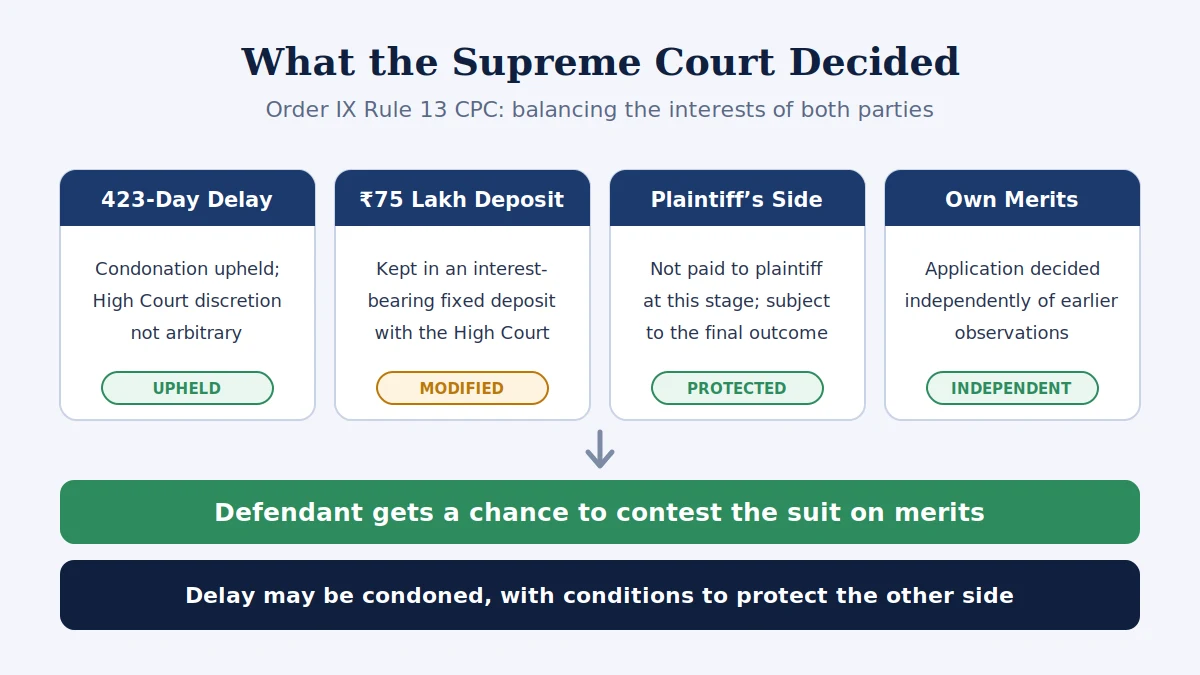
The Supreme Court declined to interfere with the decision condoning the delay, observing that the discretion exercised by the High Court was neither arbitrary nor irrational. It held that the opportunity granted to the defendant to contest the proceedings on merits should not be thwarted.
However, the Court modified the condition relating to the ₹75 lakh deposit. It held that the amount should be deposited with the High Court and kept in an interest-bearing fixed deposit, rather than being paid directly to the plaintiff at that stage. The amount would remain subject to the final outcome of the proceedings.
The Court also clarified that the application seeking to set aside the ex parte decree must be decided independently on its merits, without being influenced by observations made in the earlier proceedings.
Why This Judgment Matters
An ex parte decree does not necessarily mean that a party has lost every opportunity to contest a case. Under Order IX Rule 13 CPC, a defendant may seek to have such a decree set aside by establishing the legally recognised grounds.
This judgment demonstrates that courts may condone substantial delays where the circumstances justify it, while balancing the interests of both parties through appropriate conditions.
Conclusion
Anyone against whom an ex parte decree has been passed should promptly examine the available remedies and applicable limitation periods rather than assume that the matter is beyond challenge.
Jain Law Chambers advises and represents clients in civil litigation, including recovery suits and proceedings to set aside ex parte decrees.
Related Reading
- Section 11 CPC and the doctrine of res judicata
- Recovery of money without a written agreement: legal options in India
- Why summary judgment is the future of commercial justice in India
FAQ’s
1. Can an ex parte decree be set aside?
Yes. Under Order IX Rule 13 of the Code of Civil Procedure, 1908, a defendant may seek to have an ex parte decree set aside by establishing the legally recognised grounds. An ex parte decree does not necessarily mean that a party has lost every opportunity to contest the case.
2. Can a court condone delay in applying to set aside an ex parte decree?
Yes. The Supreme Court upheld the condonation of a delay of 423 days, observing that the High Court’s discretion was neither arbitrary nor irrational. Courts may adopt a justice-oriented approach where a party deserves an opportunity to contest the case on merits, while imposing appropriate conditions to protect the opposite party.
3. What reasons did the defendant give for the delay?
The defendant contended that he was unaware of the service of summons and was under the bona fide belief that another defendant was handling the proceedings and that the claim was being settled.
4. What condition did the Supreme Court impose on the ₹75 lakh deposit?
The Madras High Court had allowed the application subject to a deposit of ₹75 lakh. The Supreme Court modified this condition and held that the amount should be deposited with the High Court and kept in an interest-bearing fixed deposit, rather than being paid directly to the plaintiff at that stage. The amount remains subject to the final outcome of the proceedings.
5. Which case decided that delay in setting aside an ex parte decree can be condoned?
The ruling was delivered in Hiroo Hotchand Advani v. Integrated Finance Company Limited & Ors. on 28 October 2026. The underlying recovery suit was for approximately ₹21.88 crore, and the suit had been decreed ex parte in November 2021 with future interest at 36% per annum.
6. What should I do if an ex parte decree has been passed against me?
You should promptly examine the available remedies and the applicable limitation periods rather than assume that the matter is beyond challenge. The application to set aside an ex parte decree is decided independently on its merits.
Disclaimer: This article is intended for general legal information and does not constitute legal advice.
Share: