
False Election Affidavits: Can a Voter File a Criminal Complaint?
Election candidates are required to disclose prescribed information in their nomination papers and accompanying affidavits. But what happens when a voter alleges that a candidate has furnished false information or concealed material facts? Can the voter directly approach a Magistrate, or must the complaint be initiated by the Election Commission?
The Supreme Court of India addressed this question in Rajkumar Madki v. Dr. Shailendra Beldale, 2026 INSC 1138, clarifying the scope of Section 125A of the Representation of the People Act, 1951.
Key Takeaways
- A private individual can file a criminal complaint under Section 125A of the Representation of the People Act, 1951
- Such a complaint is not subject to the bar under Section 195(1) CrPC
- The Election Commission is not the exclusive authority for initiating a Section 125A complaint
- Every complaint is still assessed on its own facts
Background of the Case
The matter arose from a complaint filed by Rajkumar Madki against Dr. Shailendra Beldale, an elected member of the Karnataka Legislative Assembly. The complainant alleged that the candidate had furnished a false declaration concerning his residential address in the affidavit accompanying his nomination papers for the 2023 Assembly elections.
The Karnataka High Court quashed the complaint, holding that the restrictions under Section 195(1) of the Code of Criminal Procedure, 1973 (CrPC) applied and that a private individual could not initiate such criminal proceedings in the circumstances.
The complainant challenged this decision before the Supreme Court.
What Did the Supreme Court Hold?
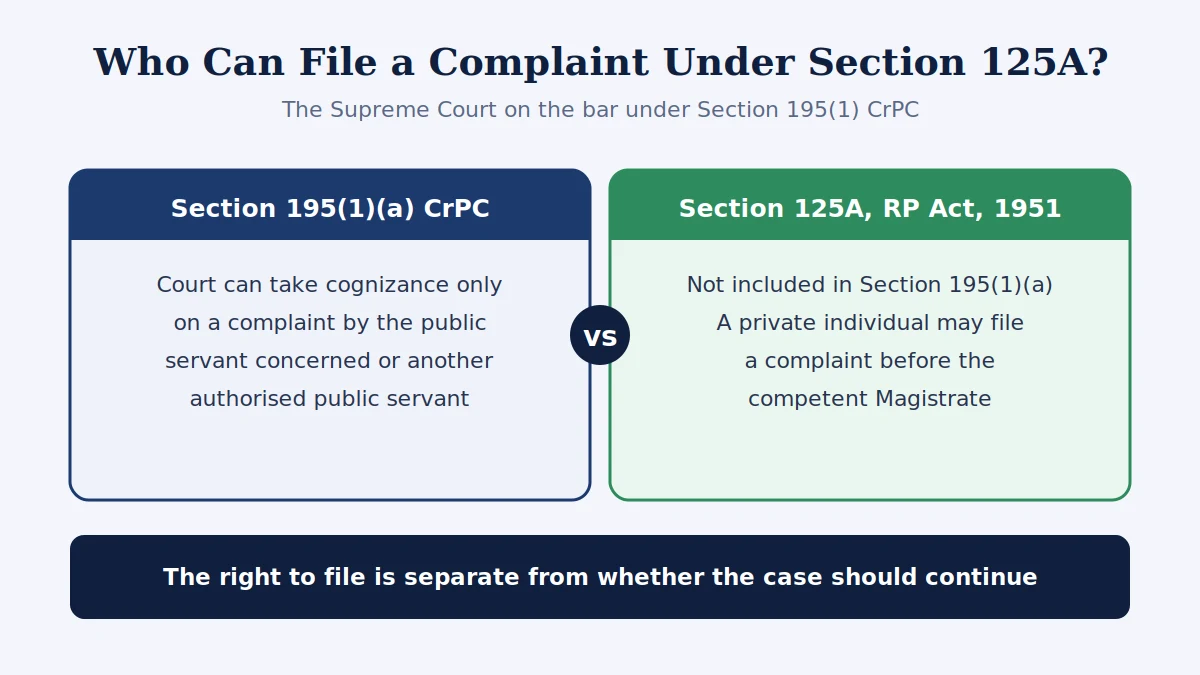
The Supreme Court held that a private individual can file a criminal complaint alleging an offence under Section 125A of the Representation of the People Act, 1951. Such a complaint is not subject to the bar under Section 195(1) CrPC.
The Court observed that Section 195(1)(a) CrPC specifies certain offences for which a court can take cognizance only upon a complaint by the public servant concerned or another authorised public servant. However, Section 125A of the Representation of the People Act is not included in that provision.
The Court therefore held that the restriction could not be extended to Section 125A when Parliament had not included the offence within its scope.
Did the Supreme Court Restore the Complaint Against the MLA?
Interestingly, although the Supreme Court disagreed with the High Court’s interpretation of the law, it did not revive the criminal proceedings against the MLA.
The Court found that the allegation concerning the residential address had been effectively rebutted by the material on record and that the possibility of conviction was remote. It concluded that continuing the proceedings would unnecessarily consume judicial time.
The judgment therefore distinguishes between the legal right of a private individual to file such a complaint and whether the facts of a particular case justify continuing criminal proceedings.
Legal Significance
The decision clarifies that the Election Commission is not the exclusive authority through which a complaint under Section 125A must be initiated. A private individual may approach the competent Magistrate, subject to the applicable legal requirements.
At the same time, the ruling does not mean that every allegation of a false election affidavit will result in criminal prosecution. The complaint must be assessed on its own facts, and the competent court retains the authority to deal with proceedings that lack a sufficient legal basis.
Conclusion
The Supreme Court’s ruling reinforces the importance of accurate disclosures in election affidavits while clarifying the procedure for initiating criminal complaints under Section 125A of the Representation of the People Act, 1951.
The judgment establishes that a private complainant is not barred from approaching the Magistrate merely because the Election Commission has not initiated the proceedings. However, the merits of each complaint must still be examined independently.
If you need legal advice on filing or defending a criminal complaint, you may speak to experienced criminal lawyers in Delhi at Jain Law Chambers.
FAQ’s
1. Can a voter file a criminal complaint for a false election affidavit?
Yes. The Supreme Court held that a private individual can file a criminal complaint alleging an offence under Section 125A of the Representation of the People Act, 1951. Such a complaint is not subject to the bar under Section 195(1) CrPC.
2. Does the Election Commission have to initiate a complaint under Section 125A?
No. The Election Commission is not the exclusive authority through which a complaint under Section 125A must be initiated. A private individual may approach the competent Magistrate, subject to the applicable legal requirements.
3. Why did the Karnataka High Court quash the complaint?
The High Court held that the restrictions under Section 195(1) CrPC applied and that a private individual could not initiate such criminal proceedings in the circumstances. The Supreme Court disagreed with this interpretation of the law.
4. Why does the bar under Section 195(1) CrPC not apply to Section 125A?
Section 195(1)(a) CrPC specifies certain offences for which a court can take cognizance only upon a complaint by the public servant concerned or another authorised public servant. Section 125A of the Representation of the People Act is not included in that provision, and the restriction cannot be extended to it when Parliament has not included the offence within its scope.
5. Did the Supreme Court restore the complaint against the MLA?
No. Although the Court disagreed with the High Court’s interpretation of the law, it found that the allegation about the residential address had been effectively rebutted by the material on record and that the possibility of conviction was remote. It concluded that continuing the proceedings would unnecessarily consume judicial time.
6. Does every allegation of a false election affidavit lead to criminal prosecution?
No. Each complaint must be assessed on its own facts, and the competent court retains the authority to deal with proceedings that lack a sufficient legal basis.
7. Which case decided that voters can file complaints under Section 125A?
The ruling was delivered in Rajkumar Madki v. Dr. Shailendra Beldale, 2026 INSC 1138, which arose from a complaint about a residential address declared in the affidavit filed with the nomination papers for the 2023 Karnataka Assembly elections.
Share: